Monday, August 22, 2011

WHY I SUPPORT THE ANNA MOVEMENT, BUT NOT HIS DEMANDS


‘Yes, we can’, this caption coined by Obama during his election campaign in 2008 for the U.S.presidential election caught the imagination of the country. And the end result was that not only did Obama win the election but won it comprehensively.

Three years later, a similar anthem is buzzing across all the major URBAN centres in the world’s biggest democracy. ‘Karengey, ya Marengay’ is the caption that is been played across the streets.

But are the two campaigns similar? On the face of it yes, they are the same, but the substance and texture are completely different.

First let’s talk about the similarities.

Obama & Anna both are underdogs fighting against the system.

In Obama’s case, a black man with no political or affluent moorings took on the system and garnered mass support to overhaul the system.

Anna on the other hand again is a simple Gandhian, who stays in a temple, has no wealth or property, with no corporate or political backing and is fighting the battle against the all powerful & mighty establishment.

Both are charismatic personalities that can woo the masses .Both took up issues that worry the common man. Both are effective communicators who seemed to have mastered the art of handling the media which in effect reaches out to a larger audience.

The media loves underdogs and it’s no surprise that in these cases they have the full support of the media.

But inspite of so many similarities there is one glaring difference between the two men.
Obama took on the system by being part of the system (political system), while Anna is taking on the system by staying out of it.

Obama’s appeal inspired his supporters to go out and cast their vote for him which translated in to him becoming the President of United States of America.This support empowered him to become the legitimate people’s representative who could take up their causes within the ambit of the constitution and bring in laws that would fundamentally bring about change in a common American’s life.

Anna on the other hand represents a section of the civil society. He is primarily an urban, middle class icon who has taken on a popular cause which has been haunting the country for the last 65 years.

Yes, corruption is an issue in the villages as well, but how many are aware of Anna’s movement? Not to forget that majority of Anna’s supporters are people who do not vote.

I totally support Anna’s movement – when he says it is a ‘Fight against corruption’. But I do not support his demand that he will fast till his ‘version of the Jan Lokpal Bill’ is passed

Anna has all the rights to protest against the establishment for not doing enough to eradicate corruption, but to blackmail that it’s ‘his way or the highway’ is not correct.

Majority of his supporters on the streets do not know the details of the Jan Lokpal bill. And these people are a' part' of the total population. By no means can we assume that they represent the majorty’s view.


As I mentioned earlier, the cause Anna is standing for is absolutely correct and the majority support him, but to say that his version of the lokpal bill is the best cannot be accepted.

Anna is not an elected people’s representative. No matter how much we argue or protest, the fact remains that the parliament is the supreme institution of democracy. The parliament is elected by the people who may or may not agree with his draft of the Lokpal bill. MPs are legitimate, elected representatives of the people. They maybe corrupt, dishonest, selfish, whatever it is, but they have been elected by the people.

This demand of Anna completely undermines the constitution which is the strongest pillar of our democracy.

Anna is an icon which this country has desperately been seeking for a long time. For a country where movie stars & sportsmen are the biggest icons for the youth, Anna is a fresh change, a real hero who inspires people.He represents the popular sentiment of the people but that does not give him the right to question the validity of the 552 individuals in the parliament who have been elected by the people across the length and breadth of this country.

Anna’s bill should be tabled through the parliament. It should be debated & fine tuned. Instead of asking the people to fast till his ‘version’of the bill is not accepted, he should ask the same people to protest till their MPs do not engage them in the process of drafting the bill and go to the parliament with their view points for a strong Jan Lokpal bill which will help address the root cause of corruption.

The Anna movement is like a flashback of the movie Rang De Basanti. In the movie the protagonists kill the corrupt minister to avenge the death of their pilot friend. But that didn’t kill corruption.

Similarly we don’t need to kill the political system, but cure it. And the best way to fight corruption and in this case of the Jan Lokpal bill is to get educated & educate others about the bill and push our elected members to pass a strong anti-corruption bill.

The Jan Lokpal bill is a strong instrument that will help us fight and eliminate corruption. But to believe that this alone will eradicate corruption is too simplistic. The battle is against corruption which is a much broader issue. We cannot make this a single point issue. And if we do then we may end up winning this battle but surely not this war.


Saturday, February 19, 2011

THE EGYPT UPRISING: GAME CHANGER FOR THE WORLD?


The Middle East uprising that began in Tunisia and turned into a conflagration by the time it reached Egypt has caught the world attention like never before.After eighteen days of relentless protests, Hosni Mubarakh was finally ousted after thirty years of rule. So what does this ‘Egypt Uprising’ mean for the world and what will be its implications?

An interesting study by Larry Diamond on Arab world and democracy highlights a few interesting points as to why there are no democracies in the Arab world.
The study observes that the notion that Muslim countries are not successful democracies is not true. Twenty nine Muslim dominated countries have a reasonably descent record of political rights as compared to sixteen Arab countries. These include –Turkey, Bangladesh, Malaysia, Albania & Senegal.

Another interesting point illustrated in the study is that out of the sixteen Arab countries, eleven states are heavily depended on the rents from oil & gas exports. In some of these countries as much as 90% of the earnings come from these exports. Most of these countries are so cash rich that they don’t have to tax their own citizens. And that is also a part of the problem. These states do not develop the organic expectations of accountability that emerges when states make citizens pay tax.
The other argument could be that not all Arab countries have oil. Now in these countries the ‘geo-politics’ comes in to play. The two prominent countries that are not oil based economies are Jordan & Egypt. But the other factor that also binds these countries is that they thrive on U.S financial aid.
Since 1975, U.S. financial assistance to Egypt has totaled more than $28 billion. And this does not include the $50 billion that has flowed to that country in unconditional military aid since the 1978 Camp David Peace Accords.
Similarly since 2001, Jordan on an average has been receiving $ 650 million in the form of economic & military aid from the U.S. This has helped both the countries to spend on public jobs without charging steep taxes.

Not surprisingly, Egypt & Jordan are the only two Arab nations that have a peace treaty with Israel. Not only has this prevented any military attack on Israel from the numerous Arab nations including Iran but allowed US to create military bases on these countries to safe guard Israel from any external threat.
But these methods could work only for the last three decades. The 21st century has a new generation in place which is more determined and ambitious. Money alone would not comfort and satisfy them, they want democratic & political rights like the millions of youngsters around the world.

But as many cynics argue that Arabs are still not ready to handle democracy because there is a deep ethnic divide in many countries. This argument also does not hold true. India & Indonesia are two good examples that prove that no matter how fragmented and deep the ethnic divide maybe, democracy given all its flaws can work.
This new revolution is bound to have an impact on the Geo- political situation in the Middle East, especially on Israel. If after Egypt a few more uprisings lead to the fall of more authoritarian regimes in fellow Arab countries than that would change the complete political landscape. The most crucial factor that will decide the future of this region would be the popularity of ‘Right wing Islamic parties’.

A huge chunk in the Arab world, especially the youth is secular. Though many of them may be anti-US because of the Israel-Palestine issue but are not radical Islamists. For example in Egypt the ‘Muslim brotherhood’ is considered a hard right wing Islamic party. But will it find support from the likes of Wale Ghonim, the google executive who used social media & the internet as a tool to ignite the Egypt revolution for freedom is the big question.

The elections in Egypt will be a litmus test not only for the nation but for the whole Arab world as that would give a sense of what the new generation of Arabs is all about. These are not only interesting times for Arabs but the whole world, as the Egypt uprising may be just the beginning of a wave that may well change the geo-politics of this century.

PRESIDENT & GOVERNORS SHOULD NOT BE POLITICIANS


The ongoing political tussle between governor HR Bharadwaj & chief minister BS Yeddyurappa in Karnataka has not only turned ugly but has reached a new low in Indian polity. It is true there are some grave charges against Yeddyurappa and morally he should have stepped down till he is proven innocent in this case but the governor has also jumped the gun by giving a go ahead for the prosecution of Yeddyurappa before receiving the investigation report.

This is not the first time that the head of state has given a sanction for the prosecution of a state chief minister but the fact that they belong to opposition parties and the manner in which both the sides are acting clearly suggest that it has become a political war.

The time has come that the post of President & governor should be strictly reserved for individuals outside politics. The role of a President & governor is to over see that the elected government and political parties are performing their duty properly. In times of emergency & crisis they have to step in to protect the welfare of the people and the state.The notion that these posts are a mere rubber stamp with no power is not true. In times of constitutional crisis and emergency the role of a President & governors becomes extremely important. The post has a lot of significance and should be reserved only for highly educated and qualified individuals from across the spectrum.

But unfortunately in India this post has become a ‘medal’ to award the loyal party workers. Rarely do you find that the head of state is someone outside the political circle and belongs to another walk of life. Even the president’s post has become a reward for party allegiance. For example, Pratibha Patel was chosen by Sonia Gandhi to become the first lady President of India despite India having so many successful women with impeccable record in public life. Patel’s biggest edge was that she had been a loyal Congress worker and extremely close to the Gandhi family.Even today out of the thirty three governors in India a majority are politicians & bureaucrats. A majority of them were part of the Congress party at some stage or the other or held important bureaucratic positions during Congress rule at the centre.

Even when the BJP led NDA was in power it chose many BJP veterans as governors. No matter how unbiased the individual may try to be in most cases he/she ends up acting biased one way or the other. Especially during crunch situations the governor is expected to favour the party he or she has been associated with. To avoid such a scenario the constitution should be amended and it should be made mandatory that the President & governors are a non-politicians. India is rich when it comes to individuals who have been successful in different disciplines of life. The best examples of a head of state were former Presidents Dr.APJ Abdul Kalam & second president of India – Dr. Sarvapalli Radhakrishnan. Both had no political background & did true justice to the post.

It has been a Congress tradition to award its loyal party leaders the ‘medal of governorship’ at the end of their political careers. The same trend was followed by other parties when they came to power. Its time for a course correction and the Congress should take the lead by awarding this post only to individuals with no history of political affiliation. Not only will this avoid biased decisions but also bolster the image of a President & governor’s post.

Thursday, January 27, 2011

THE WORLD CUP IS HERE

The countdown for the cricket world cup has started which is just three weeks away. After a cracker one-day series between India & South Africa, the tournament is been tipped to be a huge success. This world cup is important for various reasons.

It will decide the future of one-day cricket. This is the first major one-day tournament after the arrival of T20 cricket which has taken the cricket world by storm. So will the spectator turn out for the forty day tournament be as high as it used to be during the pre- T20 cricket time? Will the television viewership be as high as it used to be during the previous editions are some of the big questions. The ICC will go all out to make sure that the pitches for the event are batsmen friendly as that will make the matches high scoring.

Now what hasn’t changed is the buzz around who are the favourites to win this World Cup. Many Indian cricket experts, media houses & fans have already started believing that India is the strongest team to win this world cup. The reasons- that India has the best side, we are playing on our home ground etc. My take is that India is one of the favourites but definitely not the favourite to win this edition.

The reason is that though India has probably the best batting side but their bowling is a big concern. The two world cups in which India performed exceptionally well were 1983 & 2003. In both these edition one key reason for India’s superior performance was India’s bowling. In 1983 – Roger Binny and Madan Lal were the top two wicket takers of the tournament. Between the two they took 35 wickets in 8 matches. Kapil Dev & Mohinder Amarnath had an economy rate of less than 3 which made it difficult for the opposition to score runs. Kapil Dev also took 12 wickets in the tournament.

Similarly in the 2003 – Zaheer, Srinath & Nehra took 49 wickets together in 11 matches. Harbhajan’s economy rate was less than 4. Along with India’s batting the bowlers also played an equal important role. Now the argument could be that In India the conditions are different but even then any team would need atleast 3 bowlers who perform well. It is not necessarily to be the highest wicket takers but atleast bowl tight.

This time around India’s bowling is one of the weakest ever. Nehra is still to in to rhythm, harbhajan has been inconsistent. Praveen Kumar is struggling for fitness and even though Munaf bowled well in South Africa, in India he has never been very effective. Zaheer is the only reliable force. But given that India will play four bowlers in all matches atleast 3 will have to be in prime form. Luckily India’s part time bowlers- Yuvraj, Yousuf & raina have been bowling well. Sehwag & tendulkar are also very effective bowlers. So getting useful ten overs out of these three to four bowlers will not be a major concern.

No doubt that India has a very potent batting side with the top seven batsmen capable of winning the match for the team on any given day. But out of the seven batsmen atleast four will have to perform consistently & be in great form. Sehwag & Tendulkar will be a lethal opening combination. But Sehwag will play his natural game and like always his consistency will be the key. But his & Tendulkar’s form will be the most critical factor if India is to go through till the finals. In the middle order with Yuvraj & Dhoni struggling to for form, Gambhir & Kohli have a very pivotal role to play. Gambhir at number 3 and Kohli at number 4 will have to play the anchor sheet role. One of them will have to raise their hand in every match and stay at the crease till the end. Yuvraj has been out of form for a very long time but given his talent & calibre Dhoni has no choice but to back him. The day he finds his rhythm he can demolish the opposition. Dhoni like always will play according to the situation. His temperament is his key and will provide the reprieve to the batting.

But the ‘X factor will be Yousuf Pathan.I think it is imperative that Dhoni plays Yousuf Pathan in all the matches even if that means dropping Raina. Yousuf is a special player and he cannot be expected to play a miracle innings each & every time India is in trouble. He may click say 3 times out 10 matches. But the day he gets going he can win India the match single handedly. Sehwag & Yousuf are two batsmen who can alter the course of a match in a matter of few overs. They have to be backed no matter how inconsistent they are. If India has to win this world cup both of them will have to produce special innings in some crucial matches.

Lastly, since the 2002 Natwest trophy in England, India has not won a single major one day tournament. They have always cracked under pressure in major tournaments. So the temperament will be another key factor.


As if now without naming any favourites the four teams that should make it to semis are – India, South Africa, England & Sri Lanka. Anyone of them can win this world cup. But the surprise package of the world cup could be Pakistan. They have it in them to surprise everyone.

Monday, January 24, 2011

CONGRESS’S BIGGEST WORRY: THE COMMON MAN

During the general election of 2009 the Congress manifesto’s cover page had two opening lines that encapsulated the campaign theme for the party. The lines were –

Aam Aadmi kay badhtey kadam
Har Kadam Par Bharat Buland


This essentially means ‘As the common man moves forward, India gets stronger with every step’. And fortunately for the Congress this theme did find resonance amongst the masses which voted for them in huge numbers. But today barely eighteen months after the elections, the above message has changed to- ‘The more the common man tries to move forward, the more he will get punished’.

The events that have unfolded in the last six months have left the common man completely disillusioned. The series of scams that have unearthed, the price rise of essential food items, the growing inflation and now the second price increase of crude oil in a month has left the common man battered. The various scams that have been erupting from time to time have been disturbing, because of which the common man is saying, that first of all the hard earned tax payers money has been gobbeled by corrupt ministers and if that was not enough the price rise has become a constant phenomenon. But the bigger worry is the government’s inability to control price rise. All these events are compelling the common man to question himself –whether it was a mistake to vote for the Congress & allies for the second time?

The emergency cabinet meeting which took place for over two days and ended without any guarantee from the governement to contain the price rise has left everyone even more bemused. The government message that it can do little to bring down the prices in the immediate future but can work towards a more secure future has suddenly shaken the confidence of the common man.

There are two stark messages that the government has send out in the last six months.Firstly that ministers and bureaucrats who are involved in corruption will be brought to book only when they are proven guilty. It is easier for us to take action against our own ministers (e.g.- Tharoor, Chavan, Kalmadi etc) but difficult to take action against ministers from other parties who are our coalition partners. But how much time will it take to finish these investigations is still not known. Second, that our intention is to control price rise but there is very little we can do as most of the stock is with private players. Suddenly the common man’s confidence and faith in the Indian growth story has shaken. Now the questions is that – what is the use of this 9% growth if the we have to suffer due to due price rise and the extra wealth that is created by the government is eaten up corrupt politicians and ministers.

This sudden change in the national environment is really disturbing. The last time the country went through this phase was way back in the 90’s. But suddenly after the Kargil war the nation found renewed confidence and after that the rise in the economic growth completely changed the mood of the nation. But when ordinary citizens start questioning the growth and prosperity of the nation then it means that the government is in serious trouble.

Analysts’ believe that if elections were to be held today then the UPA will suffer a huge defeat. And for the Congress the timing could not have been worse as it is losing political ground in one of its key states - Andhra Pradesh.
The unfortunate part is that this govenrment has some very reputed ministers who have a great image and are genuinely good administrators. But the overall performance of this government is in question. The Congress cannot blame its allies because evntually it is the big brother of this coalition.Manmohan Singh is still considered an honest man and his integrity is still intact but now people want him to take some tough steps to change this mood.

If the governmet fails to act quickly, it may find it difficult to last for a full five year term. And all the ground that the Congress had recovered in the six years it may just get undone in a matter of few months. It’s time that the Congress fulfills its campaign theme on the back of which it came to power otherwise those very lines which it used as its campaign theme will become its nightmare in the next election.

Thursday, January 13, 2011

TIME TO FIX THE FIXERS

The Radia tapes revelation which is now famously been referred as the ‘Radigate’has become the biggest talking point in New Delhi. Never before has the deep nexus between the corporates, politicians and a section of the media been exposed to this degree that has left everyone stunned.

Niira Radia who was famous in the political & corporate circle has now become an instant star. She has become the symbol of a power lobbying or should we say power broker. Everyone wants to know and hear more abour Radia and her conversations with people cutting across political and business circles.The proximity between politicians & businessmen was never a secret. For decades business houses and tycoons have been funding political parties and in return politicians have helped them in growing their businesses. Many businessmen have a politician’s money invested in their companies and are business partners with them. The relationship has always been of scratching each others back and safe guarding each others interest. So why is everyone shocked to discover this nexus now?

Niira Radia who in many ways has emerged as the face of this nexus is not an exception nor does she represent a new breed which has recently taken birth. Brokers or deal fixers or dalals or let me use a dignified term - lobbyists as they are called have always existed in the system. The job of a lobbyist has always been of bridging the gap between politicians & businessmen. They are faceless but wield more power than the many potent faces in power. If the Indian system is considered corrupt then one major reason for that without a doubt are lobbyists. Whenever the businessman faces an obstacle in his business it has always been these lobbyists that solved their problem through these politicians & ministers.

There is a sense of disappointment within corporate India that these scams may shake their morale which may in turn effect the stupendous economic growth India has been riding on. Many have even send a message to the prime minister and finance minister that this crusade needs to stop otherwise it will impact the markets which in turn will impact the governments plan to raise money through capital market for expenditure. This may be a subtle blackmail or maybe even a warning.

But many belief that this whole 2G scam and the Radigate has really upset the prime minister and the Congress high command. And if the prime minister as it suggests at the moment decides to go to the bottom of this issue even at the cost of political vulnerability then it will surely send the right message to the angry public.

This is a golden opportunity for prime minister to crack down on this unholy nexus between the politicians and businessmen. By nailing down the culprits the government can actually intimidate this convenient working model shared between politicians and businessmen. And if Raja & Radia are found guilty then the government should surely punish them in the most severe fashion. The crackdown should be so severe that it sends down a shiver among politicians, businessmen & lobbyists (fixers). These fixers are the genesis of corruption as it has been proved through the Radia tapes. If the government can intimidates them it will surely have an impact on the politician-businessman nexus. This step could go a really long way in at least subsiding corruption on that level even if not completely but to a great extent. Given Manmohan Singh’s track record of being the most honest prime minister, he surely would not want to go down in history as the ‘most honest prime minister of the most corrupt government ever’.It’s time to fix the ‘fixers’ that can pave the way for India’s inclusive growth The onus is on the prime minister and his government.

RADIA TAPES- IS THE MEDIA GUILTY?

‘When the Hunter got hunted’

This was the status message of one of my friend’s on his facebook account after the Radia tapes were leaked. Much has been spoken about the 2G scam but it’s a very interesting case to actually discuss media ethics.

Media which is often referred as the fourth estate has become an integral part of Indian democracy. The print media was always vigil for the past six decades but the real turning point came when the electronic media (TV) made an entry. The whole coverage & news reporting approach has taken a three sixty degree turn in the last one decade or so. Expose, sting operations, sound bytes, powerful visuals have all changed the dynamics of the way media functions. Till one & half decade back the only piece of television news one saw was on state run Doordarshan which at best can be described as the mouth piece of the government. The entry of private media players marked the real change in news reporting.

But unlike other institutions media is primarily a private driven enterprise and therefore is not under pressure from the government. The involvement of two celebrated journalists- Barkha Dutt (Group Editor of NDTV English) & Vir Sangvi (Consulting Editor of Hindustan times) in breaking the deadlock between Congress-DMK at the time of government formation in 2009 has come as a real shocker.
Just to give a clear context the tapes also contains conversations of Radia with Barkha Dutt & Vir Sanghvi at the time of government formation in 2009. Radia is heard lobbying for the DMK, while both Dutt & Sanghvi are seen to be presenting views of the Congress. The conversations indicate that Radia asked Dutt & Sanghvi to use their access to the Congress to pass on messages from the DMK.

Most people are shocked to see that two stalwarts of Indian journalism were involved in the lobbying process which has to a great extent tarnished their image. Journalists are not expected to be involved in any sort of deal which may not be monetary in nature but may lead to one party benefiting.

Dutt & Sanghvi are not corrupt but the fact that they were part of the lobbying process is a shameful act. On their part both have denied to have passed on those messages to the Congress leaders. They both claim that they were playing along to extract information and did not pass on those messages.

So what are the charges against these two journalists? No one is alleging corruption charges against them this act is a clear breach of media ethics. Journalism is all about of credibility and if that takes a beating then the journalist’s past track record & image does gets tarnished. Both have accepted that they should have handled Niira in a proper manner.

Journalist as a part of their job to extract information talk to all sorts of people from all walks of life. But there is a thin line between extracting information and divulging details that can benefit the source. Both Dutt & Sanghvi have crossed that line or at least seemed to have crossed that line. Both have done a mistake and should apologize to for that

But this brings me to a bigger question- Can the whole institution (Media) be painted with same brush. Now that is a very narrow & prejudice way at the looking at it. Yes, this incident has raised questions on the ethics followed by journalists but the medium is still fair & honest in its approach. The biggest testimony of that it is that the very same media that has actually made these tapes public without any fear of the whole institution’s image take a beating.

Like any other institution media also has grey areas and these tapes are example of that. So if there is a certain section (which is a small section) that believes that media in general is like that then by that principle – the army will have to also called corrupt because some its top officials were involved in Adarsh scam and the Tehelka scam which broke a few years back. They will also have to call the whole judiciary corrupt because of judges like Justice Dinakaran. Outlook magazine have made 141 tapes public, out which Radia has spoken to over thirty journalists. But the ones who have been found guilty on account of breach of ethics are hardly six to seven. The remaining twenty five odd have come out clean. This clearly shows that it’s not the whole institution that practices poor journalism. There are always a few rotten apples in the basket and it’s important to throw them out before they spoil the basket. And that is what is needed.

The same friend who I mentioned at the beginning of this piece also put a this status message
Radia deserves the Padma Bhushan for this expose’

For those people – had it been not this media then the multi crore scams like – CWG games, IPL, Adarsh society & now 2G scam which saw the exit of two cabinet minister, one chief minister & one sports administrator would have never happened. That is the impact of a genuine & vibrant media. Instead of asking for severe punishment for corporate lobbyists who work only & only for the benefit of corporates & politicians this friend of mine is much happier to see media found guilty for once forgetting all the work media has done for so many decades. Well, despite a section of cynic Indians the nation has overcome obstacles and shall continue to in the future as well. As for the media and journalists- this is a big lesson to look within and take corrective measures to ensure that the over all credibility remains intact.

OBAMA’S VISIT: WHAT THIS MEANS FOR INDIA

The Obamas have danced their way in to the hearts of normal, average, middle class Indians. Their grace, humility & affection seemed genuine and all these traits are weakness of an average India. Obama’s speech to the parliament will without an element of doubt go down as one of the most historic speeches ever and this trip may well redefine the US-India relationship.

But many skeptics still believe that United States has gained more from this trip and India has got carried away BY Obama’s kind words. Some cynics feel that the United States showed the UNSC carrot and India gave in. So has India really got carried away? The answer is simply ‘no’.

The trip has three broad features which I shall discuss one by one.
Economic & trade partnership- Skeptics believe that this trip was largely about businesses deals which will benefit United States and India has nothing to gain. Now looking at job creations in the United States through the $10 billion business deals is just one side of the story. Primarily India is paying to get access to technology in multiple sectors which so essential to keep the brisk growth rate of India’s economy on track. United States has an edge when it comes to technology and India is simply going to benefit by getting access to it. Partnership in areas like energy, defence, space, agriculture & manufacturing will bolster the capability & capacity of Indian companies which in turn will also create more employment in India & enhance our GDP growth. And if these partnership are utilized to its fullest potential than India can also touch 10% GDP growth from the current 8% growth. India needs the expertise in areas like agriculture which employs more than half the population and could also help in creating another green revolution which could do wonders for our agriculture sector.

Till now the US had restricted technology transfer to India but with post this trip US will lift those restrictions. With India getting access to technology especially in areas like agriculture, space, defence & infrastructure will only enhance our growth rate as mentioned earlier.

Now many critics say that there was no need to buy defense equipments from the United States given that we can get better deals from Russia & France. India’s increased defense purchase from United States doesn’t mean that it will stop buying from other countries. Russia is still India biggest defense supplier followed by Israel. United States traditionally had a very small pie in the Indian defense segment. And there should not be any fear of not getting access to the defense technology in the future because that will hurt US companies much more. This is something which the United States realized during the recession.

The Pakistan issue- To expect United States to impose sanctions or take some ultra tough measures against Pakistan for not acting against the perpetrators of 26/11 is not going happen. For United States priority is Afghanistan and for that it needs the support of Pakistan. And any direct involvement of the US in eliminating terror groups in Pakistan may also lead to a back lash and jeopardise US’s Afghan-Pak strategy. But on the first two days of the trip Obama did not mince any words against Pakistan for the 26/11 which also drew huge criticism.But it was on the last day that Obama said it a loud in the parliament speech that Pakistan will have to bring the culprits of 26/11 to book. As Swaminathan Aiyer put is across- US’s strategy is very clear. For the short term its Pakistan and in the long term it’s India. Obama also made it clear that it will not interfere in the Kashmir dispute and will leave it to India & Pakistan to sort out the issue something which India has been saying all this while.

Support for UNSC seat- Well, this was in the offing for a long time. Even the permanent members on the UNSC realize that there is a need to reform the United Nation’s Security Council based on today’s world order. India’s economic clout, growing influence on global issues, strong democratic track record & contribution to peace keeping efforts makes it’s a strong & deserving candidate to claim a permanent seat on the security council. China’s growing influence & uncertain behaviour is a cause of concern for the United States & Europe. In order to keep a balance India’s elevation is imperative to keep this region stable. With four out five permanent members already supporting India’s candidature including the United States, India chances look bright. Though China will try to create obstacles but that would be a real test of India’s diplomatic mettle. And the reform of the UNSC itself might take a few more years.

Many people also skeptical that India’s growing closeness to United States will drift it away from its old friend –Russia. This is not true. The cold war era is completely over and the fall of the Soviet Union also dismantled the bipolar world order. India’s relationship with Russia will & should continue to remain strong. India would need the support of both these nations to realize its true potential which is essential for this region. Obama’s endorsement should not be seen just lip service but an articulation of India true position in this century. As Obama put it- that India is not emerging, it has emerged.

Saturday, October 30, 2010

MODI’S WIN IS THE BEGINNING OF BJP WAR


Narendra Modi has done it yet again! His emphatic win in the urban & rural local body elections may not be really surprising but the fact that over 100 Muslim & Christian candidates won on BJP ticket has come as a real stunner.

There is no doubt that Modi is the king on the Gujarat turf for the last one decade. And going by the current trend, Modi is the favorite to win comfortably in the 2012 Gujarat assembly elections. With the Congress still finding it difficult to resurrect itself in the state, there is little doubt that Modi will face any major challenge in winning the 2012 elections but Modi’s new strategy of fielding Muslim candidates in Muslim dominated areas has brought rich dividends and is also a clear indicator of Modi’s long term game plan.

This victory has also set the ball rolling for an even more intense battle that is brewing within the BJP. Modi has his sight clearly set on the 2014 General Elections. Modi’s biggest strength has been his pro- development image but his biggest negative still remains the Gujarat riots of 2002 which continue to haunt him. In order to change that perception of being an anti Muslim leader, Modi is now going all out to woo Muslims. During the last state assembly elections, Modi did attack Muslims indirectly. For instance he referred to General Musharraf of Pakistan as ‘Mian’ Musharraf (Mian is a urdu word used to refer to Muslims). He also hit out at the UPA government for investigating the Soharabbudin case & criticized the Congress for being the messiah for the Muslims. But it’s suddenly in the last two years or so that Modi is talking about developmental politics and criticizing vote bank politics. The irony is that Modi himself was induldged in vote bank politics until recently.

But 2014 will be very different from 2002. Modi realizes that the political issues that mattered ten years back are no more relevant for the common man. And most importantly there is a leadership crisis within the BJP. With so many factions within the party there is no clear second generation leader after Advani. Even thought the Sushma Swaraj- Arun Jaitley group seems to have an edge at the moment due to Advani’s backing, but the ground reality remains that Modi has been BJP’s most successful leader on the state level and Modi is now desperately trying to modify his image which just might come in his way to become the prime ministerial candidate of the party. Sushma Swaraj last week announced that Modi would not campaign in Bihar & also added that his ‘charisma’ & ‘magic’ may not work in Bihar. This clearly signals that Sushma wants to ensure that Modi does not move to national politics from state politics as that would weaken the Jaitley-Swaraj hold within the party. It is no secret that a huge faction within the BJP supports Modi’s candidature to spearhead the party campaign on the national stage.

It won’t be an easy task for Modi to let go off the anti-Muslim tag that has been attached to him from 2002. Even some strong allies of the NDA, especially the JD (U) which is led by Nitish Kumar will never join hands with the BJP if Modi is projected as the prime ministerial candidate. But Advani’s claim that Muslims are more economically empowered in Gujarat compared to any other state in the country was indirectly an appeal to the Muslim community to forgive Modi. This public appreciation for Modi by the BJP patriarch indicates that the party top brass still considers him as the strongest second generation leader. Whether he will be able to make the cut and pip other senior leaders is still to be seen. But the battle for 2014 within the BJP has definitely begun. But the real decider on this issue would eventually be the RSS.

Tuesday, October 19, 2010

THE SHAME STORY OF KARNATAKA POLITICS


The scenes of Karnataka MLAs fighting in the assembly with their shirts torn and worst of all MLAs beating up security marshals was probably the lowest point of Indian politics. To call it a shame would be a sheer understatement but this is not the first time that Karnataka politicians have embarrassed the state.

It was only last year when 57 BJP MLAs led by illegal mining barons- the Reddy brothers held the Yeddyurappa government to ransom by threatening to withdraw support unless some of the ministers were not dropped. And this all was happening at a time when the state was suffering due to the worst ever floods that had hit the state.


The unfortunate aspect of this whole episode is that all the actors involved have made a mockery of democracy. The two unbiased members of the whole system- the governor & the speaker who are the guardians of the constitution also let the constitution down by placing their parties over state.

The tragedy is that Karnataka which was considered as the most progressive state till the 90’s has suddenly become a disgraced story. All aspects of the state have taken a major beating. For instance Bangalore or Bengaluru as it is called now was considered as one of the best cities to live in India till the 90’s. But the sudden influx of migrants due to the booming IT industry & better educational prospects crowded the city. And by the time the state woke up it was too late. The metro rail project which was supposed to start way back in 1993 finally took off in 2005 due to lack of political will. The city which was known for its greenery was turned into a concrete jungle and all main roads were dug up for the project which has made driving in Bangalore as nightmare.

The unfortunate aspect of this whole episode is that all the actors involved have made a mockery of democracy. The two unbiased members of the whole system- the governor & the speaker who are the guardians of the constitution also let the constitution down by placing their parties over state.

The tragedy is that Karnataka which was considered as the most progressive state till the 90’s has suddenly become a disgraced story. All aspects of the state have taken a major beating. For instance Bangalore or Bengaluru as it is called now was considered as one of the best cities to live in India till the 90’s. But the sudden influx of migrants due to the booming IT industry & better educational prospects crowded the city. And by the time the state woke up it was too late. The metro rail project which was supposed to start way back in 1993 finally took off in 2005 due to lack of political will. The city which was known for its greenery was turned into a concrete jungle and all main roads were dug up for the project which has made driving in Bangalore as nightmare.

Even the cosmopolitan nature of the city transformed within years. Once known as the city of pubs & the rock capital of India, Bangalore was known for its vibrant night life and women safety. But with the so called moral forces taking charge, the city’s night life suddenly collapsed with all pubs & discotheques shutting shop at 11 PM, the last movie show starting at 8-45 PM & even restaurants shutting by 11 PM. The city which was known for women safety also became unsafe for women to travel late nights. Multiple cases of women raped and in some cases even murdered put a blot on the city’s clean image.

In 2005 the Kannada film association forced a ban on all non-Kannada movies to release in the state. This was a clear violation of the citizen’s right to freedom. But the government at that time which was a Congress –JD(S) coalition remained silent on the issue and did not take any legal action against the perpetrators. The most appalling act was displayed by a group of hooligans who call themselves the ‘Sri Ram Sena’ when they openly attacked young girls in a Mangalore pub in broad day light in the name of culture and moral values.

And all of these instances have a pattern. All of them are linked to political groups in one way or the other. The political fraternity has failed to uphold the values of average Kannadigas. Not so long ago the States’ Lok Ayukta’s chief – Justice Hedges had stepped down in the wake of spiraling corruption that had entrenched the political & bureaucratic system. It was after a lot of deliberation that he agreed to stay back.

Karnataka has a history of producing renowned citizens who have made this country proud. CV Raman, Dr Devi Shetty, NRN Murthy, Azim Premji, Anil Kumble, Rahul Dravid are a few extraordinary Indians the state has produced. But so has the state given a person like S. Manjunath, who was killed by a petrol pump owner for exposing corruption. Manjunath was an average middle class boy who passed out from IIM but chose to work in a government company to serve his country. But yet was killed for doing his duty honestly. The Karnataka politicians are doing exactly the same thing; with each disgraceful act of theirs they are killing the proud spirit of an average Kannadiga.

Saturday, October 16, 2010

THE GENERAL IS INDIA’S BEST BET


He is out of power and is loathed in India for his role during the infamous Kargil war. But the fact remains that General Parvez Musharraf is the most pragmatic individual in Pakistan politics who can deliver on the Indo-Pak issue.

There is no one better then Musharaff who understands the Kashmir dispute in Pakistan. He was involved in all the major wars between India & Pakistan. He fought his first war against India in 1965 as a 2nd Lieutenant which was followed by the 1971 war where he served as a company commander in the Special Service Group. But Musharraf will be always remembered for his role in the Kargil war, which many say was his game plan.

But the other side of the coin is that it was also during his rule as dictator of Pakistan that both India & Pakistan took some significant steps towards resolving the issue. His first visit to India in 2001 for the Agra summit was a big failure but it was his second visit to India in 2005 when he met Dr Manmohan Singh set the ball rolling. Musharraf himself has confessed that the two countries were on the brink of signing a historic peace deal which would have opened a new chapter in the relationship of the two countries.

There are various factors that make Musharraf a reliable candidate to deliver on the Indo-Pak issue compared to other Pakistani politicians. The first major factor is that being an armyman Musharraf will walk the talk on what ever is decided on this issue as he wouldn’t strike the deal to just reap electoral benefits. The second critical point is that being an ex-army General himself, Mushrraf clearly understands the dynamics of the ISI and its support for terror based groups that have been waging a war against India. And he would also know the exact approach to get the army on board to strike a deal with India.

Musharraf was part of the army’s top brass when insurgency in Kashmir started to bolster with the tacit support of the army & ISI. And ironically it was Musharraf who started to clamp down on the terror groups based in the western & northern region of Pakistan.Pakistani politicians will always remain ineffective to take action against terror groups that have been targeting India for the simple reason that they will face the flak from Islamic fundamental parties. The counter argument to this could be that if at all Mushraff makes a come back this time- it will be as a politician and therefore he won’t be able to move comprehensibly on this issue.But my assessment is that if there is any chance for Musharraf to make a comeback even if it is in the capacity of a politician it cannot be without the support of liberal Pakistanis and parties. So that will give him the mandate to approach this issue without any major political hiccups. And Musharraf being an ex-General surly knows what would be acceptable to Pakistan army on this issue.

Having fought three wars with India, Mushraf understands that Pakistan will be a bigger loser in the long term compared to India if tension continues to escalate between the two nations. Pakistan’s economy will not be able to grow unless the region is stable & it won’t be able to catch up with other growing nations. Another distinct trait of Musharraf is that at heart he is still a soilder with immortal love for Pakistan, which cannot be compared to any politician in Pakistan & therefore he would want to leave legacy behind that would benefit Pakistan for years to come.
Given the volatile nature of the state of Pakistan and its polity, Musharraf is someone who can do serious & meaningful business with India. But the bigger question is that whether Musharraf’s dream of coming back to power through the political route will just remain a mirage? With no cadre base, no matter how big the personality maybe, it won’t be easy to climb the political ladder. Imran Khan is a classic example who till date has not been able to make any major inroads in Pakistan politics. But the enigmatic General is known for suprises and this time too he just might prove his critics wrong. And funnily the soilder who fought three bitter wars against India is their best bet to end the six decade old deadlock.

Sunday, October 10, 2010

THE REAL WINNER OF THE AYODHYA VERDICT


On 30th September around 4-15 PM when the first set of lawyers stepped out of the court and got caught in the media cacophony, the only sense one could make was the victory sign flashed by half a dozen lawyers in that large contingent indicating that it was a decisive victory for one party. But thankfully even before the audience could decode the judgment, the news channels started to flash: 2-1 the judges rule in favour of dividing the land in to three equal halves.

On the face of it the judgment has something for both the Hindus & Muslims. Even though many critics have slammed the verdict and termed it as a legal disaster & the Muslims groups feel that it is tilted in favour of the Hindu groups, yet they all have accepted the verdict with dignity & humility.


But there are five important factors that emerge from this verdict-

Statesmanship displayed by the Court

From a nation’s point of view there could not have been a better judgement. The court bearing in the mind the sensitivities involved in this case has delivered a verdict that has left something on the table for everyone at the same time denying comprehensive victory for one party. But by this verdict the court has also shown the government what it could have done many years back even before this issue devastated our nation. So in that sense even if this verdict is ‘panchayati’ as termed by many critics, it still is the most spirited verdict and highlights the statesmanship displayed by the court.

Legal questions

From a legal point of view, this judgement has fundamental flaws. No doubt the court with the best of intentions to keep the nation calm has approached the case in an extraordinary manner but even then the basic fundamental question it has given birth to is that whether the court can place ‘faith’ over evidence to pronounce its verdict. The cause of concern is as pointed out by many legal experts that this can set a wrong precedence for future legal cases pertaining to places of worship. These are valid concerns as the judiciary of this country has always been seen as a symbol on unbiased justice. And without doubting the intention of the court in this case the problem is that there could be far reaching ramifications if this verdict has legal & constitutional flaws.


Supreme Court’s critical role

In all likelihood the case will move to the High Court as some groups have already announced. The Supreme Court’s role is significant for two reasons- 1) The Supreme Court will give the most impeccable decision based on legal grounds which is expected to address the legal loopholes which have emerged after this verdict 2) The decision of the Supreme Court will also put to rest the fate of this issue legally at least which may lead to a closure. Which means that all parties involved in this case will either have to accept it and hopefully with dignity given that all the parties have maintained so far that they will respect the judiciary. The Supreme Court verdict will also give a clearer picture of the constitutional aspect of this case which could set the blue print for any out of court settlement.

Verdict cannot validate 6th December demolition

Another concern for the Muslim community & secular forces are that does this verdict validate the demolition of the mosque on 6th December 1992? Constitutionally & legally the demolition was a criminal act and shameful for our democracy and there are no two ways about it. And there is already a separate case under trial which is dealing with demolition issue. So mixing both the cases is the wrong way to look at it. This case was entirely a civil case fought for the possession of a private land. On the other hand the demolition case is a criminal case and pertains to the failure of law & order.

Out of court settlement

This case has possibly given a good foundation to reach an out of court settlement which would be the ideal solution. Because frankly, other then the parties involved, an average Hindu or Muslim really doesn’t care. All the parties can now adopt a more pragmatic approach that can pave way for an out of court settlement. No party can have it their way completely as is evident by this verdict. So working out a middle way can solve it once and for all, which is possible post this verdict.

The biggest winner: Our Indian secular faith

As I had mentioned in my prelude to the Ayodhya court verdict that this judgment will test the real faith of this nation. Is the fundamental religious faith still stronger than the secular democratic faith was the big question? And the average Indian has displayed they have moved on and realized that the 1992 time was a dark phase of our democracy and that will only make us regressive. No doubt that barring a few diluted politicians like Mulayam Singh, all political parties reacted in a very mature fashion which made this verdict even sweeter. This reaction has reinforced the belief that we are a nation that is ready to accept mistakes and rectify them for out larger good. The battle that was fought for 60 years in the court between Muslims and Hindus finally has a clear winner- and that is ‘the Indian secular faith’.

CWG MESS: INDIA EXPOSED

A new revelation about the Commonwealth Games just keeps pouring in. Every day, a new abysmal update on the preparation front emerges and adds to the embarrassment. But, going by the way the CWG officials have been reacting to the whole mess, a few things about us, as a nation, have become distinctly clear.

1) Hygiene! Whats that? - Even though the infrastructure & facilities are world class and much better than the previous CWG venues, the organizers ignored the basic hygiene issue which has completely overshadowed the other positive aspects of the ‘Games Village’. Even if the media has over blown the issue, the fact remains that the organizers didn’t consider this as a priority. This clearly reflects from Bhanot’s statement that cleanliness & hygiene is a perception issue and the Indian standards differ from international standards. For any normal person this would sound absolutely absurd, but there are many who may not say it openly but agree that Indians are, by nature, not cleanliness freaks.

2) Babus (Bureaucrats) do it again - The whole event was executed by bureaucrats working in different government agencies. And when all these agencies are headed by people who have worked all their lives like bureaucrats, the situation can’t get worse. Kalmadi, Gill, Bhanot etc epitomize the ‘ineffecient working attittude’ of bureaucrats that has always failed this country. Had a private company organized the same event, then the scenario would have completely different.

3) The Eleventh hour tendency - Yes, our government is trying to put things together at the eleventh hour, as always. This has always been the case that government wakes up only when the damage is done. It’s unfortunate that a nation which boasts of citizens & corporates that are known for their on time performance across the world has completely shattered that image by this performance by all measures.

4) The complacent attitude - The best way to describe this attitude is in Hindi which is the ‘Chalta hai’ attitude. The government & bureaucrats are known for running this country with this complacent attitude. And the reason why this attitude has just got worse over the years is because of inaction against them. These people will never get fired no matter how slow, corrupt and inefficient they are at work.Again, the same can’t be said for the corporate private sector which has given a new shape to this country.

5) What’s Accountability? - No matter what happens, no one knows who is accountable. Kalmadi blames the Delhi government, the same Delhi government blames agencies & then some blame the weather and the blame game continues. Yes, everyone is calling for Kalmadi’s head but that won’t be enough. The whole committee, including politicians & bureaucrats, should to be taken to task after the games end.

6) Event over, scandal forgotten - I fear that this might happen yet again. Once the games are over and by chance if they pass off even in a smooth manner compared to the present mess, then everyone will start congratulating each other for the good show considering that the Games were in such horrible shape before they started and how everyone pulled up their socks and made the games a success. All the filth, delay, corruption charges are forgotten. Let’s not repeat it this time. No matter how good the games go, the damage is done. We are a laughing stock across the world.

Many people I have spoken to are of the belief that this a propaganda to embarrass India which has been creating waves across the globe for the last few years. This is again an escapist attitude. We Indians are good enough to judge ourselves whether we are been targeted or we have actually goofed up. Many would say that by Indian standards we have done very well but by international standards we were behind…To all those people, please wake and smell the coffee…it’s the 21st century and we are an emerging super power…And to achieve that position we have to learn how to accept our negatives.

Wednesday, September 22, 2010

AYODHYA VERDICT: THE BATTLE OF FAITHS


On September 24th the Allahabad High court bench will pronounce the Ayodhya title suit verdict after sixty years. The title suit case was first filed in December 1950 by Mahant Ramchandra Das Paramhans which was followed by several more suits filed by other parties including the Sunni Central Boards of Waqfs, UP, in December 1961. A total of four suits were clubbed together and brought before the Allahabad High Court which began recording oral evidence in July 1996.

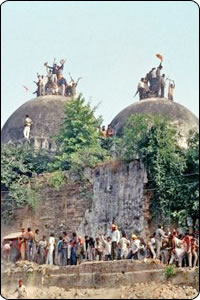
The interesting point is that the court will decide whether Lord Ram was born at that very same disputed piece of land where the Babri mosque structure stood. The whole Ayodhya movement began as a socio religious issue in the

19th century and became a burning political issue by the late 1980’s which changed the political landscape of this nation. BJP’s LK Advani spearheaded the whole campaign via his Rath Yatra that bolstered BJP’s electoral strength.

‘Faith’ was the single most important factor on which this issue was carried forward. Many middle class average Hindus also subscribed to the belief that Lord Ram was born there and Mughal King Babar in the 16th century demolished an existing temple and constructed a mosque which was known as the Babri Masjid post independence. On 6th December 1992, the Babri mosque was demolished by Hindu activists, which led to one of the worst communal riots in different parts of the country which claimed thousands of lives.

Without getting into different versions of history advocated by either side, the real issue is that the court will decide whether Lord Ram was born there and if a temple existed before the Babri mosque was constructed on that site. An issue which never got solved through an out of court talks that will be decided in the court of law on the basis of ‘material’, evidence & documents. Though all parties involved in the case which includes the right wing Hindu groups, Muslim groups and the political parties have appealed to maintain peace and accept the court verdict, almost all of them have suggested that the legal option of going to the Supreme Court is still open to them if either side is unhappy with the verdict. The irony of the situation is also the stand of two principle political parties which have been at the heart of the problem. The BJP which captured power on the back of this issue is now in a situation where it is trying to reposition itself as a moderate right wing party in order to strike a chord with the new generation. On the other hand the Congress which has never taken a clear stand on the issue and has changed its position depending on the prevailing political environment and is now in the process of regaining the confidence of the two opposing sides in this case-the Muslims which had deserted the party after the demolition and upper cast Hindus which traditionally supported the cause of the temple. In a sense everyone wants to avoid the verdict to prevent any communal disharmony to resurface.

A majority of average Indians today are of the opinion that the verdict really doesn’t matter now. India has moved on and there are more important issues that matter rather then a mosque or temple. Faith is a matter of trust in an idea. So the response of an average Indian irrespective of the religion after the verdict is something that will shape our faith in the idea of secularism. Majority of Hindus in India are secular in their thoughts and this has been proven by the previous few general elections where they did not vote for the right wing parties like the BJP which fought elections on the Hindutva plank. It has always been politicians (even in this Ayodhya issue) that have used religion to create disharmony by mixing politics with religion. But time and again post 1992, the secular faith of Indians have stood out against hard-line religious faith. Barring the Gujarat riots of 2002, Hindus & Muslims have stood united even when fundamental groups have targeted places of worship.

The ideal solution for this particular issue would be to construct a hospital at the disputed site which would do service to the society irrespective of religion. But no matter how romantic this idea of secularism may sound, the fact remains that history has been a testimony that even though India has changed from time to time, communal violence has been a constant part of our post independence history. And that is why cynics are worried that the Ayodhya verdict might just put the lid off the volcano and destroy the communal calm & peace that has prevailed for the last one decade. The court verdict on September 24th will not decide the winner between Hindus V/s Muslims but between the ‘Hard line Religious Faith’ V/s the ‘Indian Secular Faith’. And let’s hope that Gods of all religions bat for the latter.

Tuesday, September 14, 2010

RAHUL & SONIA'S NEW GAMEPLAN

Sonia and Rahul Gandhi’s recent political rhetoric to woo farmers and tribals gives a clear idea of Congress’s strategy for the coming four years before the general elections of 2014. Rahul’s staunch support for tribals against Anil Agarwal-owned Vedanta Group and Sonia’s support towards farmers has set the ball rolling for 2014 elections.

In the 2009 elections, three factors played a key role in bolstering Congress’s strength in the Lok Sabha:

1) The consolidated vote of the minorities, primarily the Muslims, which form 14% of the total votes.

2) The urban middle class voters, who traditionally voted for the BJP, overwhelmingly supported the Congress.


3) The Uttar Pradesh surprise where the party won 21 seats; thanks to the stupendous support it got from the farmers and Muslims. The Congress won 206 seats which were way better than the 2004 tally when they won only 145 seats. But, surprisingly, the UPA is finding it harder to cope with allies even though the ‘Left parties’ have become irrelevant this time around.

With Dr. Manmohan Singh serving his last term as the Prime Minister, the Gandhis realize that the call to make Rahul Gandhi as the next Prime Minister are going to get louder in 2014. Congress observers and insiders say that Rahul is very clear that he wants to head a Congress government without any coalition partners. And now, after regaining the confidence of Muslims and urban voters, the Congress wants to win the support of the remaining crucial vote banks.

Tribals form 8.2% of the total population of India according the 2001 census. Between 1947 and 2000, around 60 million people are estimated to have lost their means of livelihood in the name of development — of which a significant 40 per cent are tribal people. This initiative by the biggest political heavy weight - Rahul Gandhi is bound to get huge support among the tribals.

With over 65% of the population dependent on agriculture, the Congress does realize that farmers are not only a big vote bank but can turn the tide of any election. In the previous election - the farmers’ loan waiver scheme played a huge role in tapping the rural voters. Mamata’s political resurrection in West Bengal; thanks to the land acquisition issue and the farmers protest in Uttar Pradesh have a clear underlying message – take up the farmers’ prime cause and reap electoral benefits.

No wonder then that Rahul and Sonia have their objectives clear: to win the support of these two critical sections which will be instrumental to win a clear majority. But the peril of this strategy is that this could pose a worry for the middle class. In both these instances, it is the development and industrialization issues that will take a back seat and that may send a wrong message to the middle class which has been the biggest beneficiary of the Indian growth story. Though Rahul’s big strength is his popularity among the youth, the middle class gets easily wooed by symbolic gestures. Remember in the last election Dr. Manmohan Singh’s gamble to put his chair on the line for the nuclear deal did wonders for the Congress in urban centers.

The Gandhis are known to keep a close eye on the ground zero and they will try to strike a balance between development and social issues. But even a slight wrong footing could change the equation. It is a dangerous path that the mother-son duo is treading but risk is something that they are used to and this time it will be no different.

Friday, September 10, 2010

CWG: ACID TEST FOR INDIA’S GLOBAL IMAGE


In the last two decades, the perception of India has changed drastically across the world. From being perceived as a poor socialist country, India is now regarded as an economic superpower of this century. India’s position on global issues carries a lot of weight with the western powers wooing India to become its ally.

Major sporting events, on the other hand, are considered as a platform to showcase the strength and progress of a nation. No wonder then that even in the two decades, all the major sporting events like the Olympic Games, FIFA world Cup, Asian Games and the Commonwealth Games have been hosted primarily by developed nations.

All these events are organized by a major city or a metro of a particular country. The superficial perception is based on the infrastructure of the host city which is on display during the course of the event and other key human index parameters are ignored.

For example, the recently held FIFA Football World Cup hosted by South Africa was considered a huge success. Even though South Africa is 129 on the human index list, just five positions ahead of India which is 134. But all the statistics became oblivion when the world cup got over.

But the upcoming Commonwealth Games will be the first major global event organized by India post-liberalization. The last time India organized a major event was the Asian Games in 1982. The Cricket World Cup in 1987 and 1996 were also major sporting events but cannot be considered on the same scale as Asiad as the viewership and the number of nations that participated were too small compared to the Asian games.

In 1982, when New Delhi hosted the Asian Games, India’s economy was nearly $194 billion and was considered an under-developed nation. But still it managed to organize a successful event which bolstered New Delhi’s image. China, which is 92 on the human index list and falls under the ‘medium developed country’ category, showcased itself as a nation with world class urban infrastructure during the 2008 Beijing Olympics. The only advantage China had was that there was no free media coverage allowed before the inauguration of the games. So basically no one outside China has a clue about China’s preparations.

The progress of CWG preparations in New Delhi, on the other hand, has not only been reported by the Indian media but also the international media. These games have so far been considered as a golden opportunity for India to reinforce the perception that India will be one of the biggest super powers of this century.

But India’s failure to host these games successfully will not only raise questions on India’s progress on the development front but will also be linked to other human index indicators. Because, remember the world has just been hearing about India’s emergence on the world stage on the basis of media reports and economic indicators. But they haven’t got a chance till now to take have a close look at infrastructure development made by India. The stereotypical perception of India has always been poverty, slums, BPOs, rural India etc., as showcased by a plethora of international documentaries and movies. Even the 2009 Oscar winning movie - Slumdog Millionaire - showed the stereotypical elements of India like poverty, slums, riots and the BPOs.

That perception can be changed by hosting a world class event. Ironically, the success or failures of these games will not have any impact on the real problems of India. It won’t change the lives of the poor farmers’ committing suicide or uplift the 30 odd percent people living below the poverty line. But it will surely boost the Indian pride no matter how superficial it maybe.

Wednesday, August 18, 2010

INDIA’S GREAT KASHMIR BLUNDER


The summer of 2010 will not forgotten in Kashmir for decades to come. Even as the tension on the streets of Kashmir was not enough which has already witnessed killings of more than forty people that the state was hit by another tragedy- the flash floods which has consumed 100 lives and nearly 200 people are still missing as I write this article.

Militant insurgency in Kashmir started to surge way back in 1989 but never in the last twenty years had the anger on in the valley (Kashmir) reached a level where women & small children had taken to the streets to display their anger, frustration & agony by pelting stones at the paramilitary forces. And what has come as an even bigger surprise is that only nineteen months back during the state assembly election the voters’ turnout touched sixty percent which was seen by many as the end of Kashmiri nationalism and the beginning of new era in Kashmiri politics. So what went wrong in the last nineteen months that has lead to this catastrophe?

For the past 62 years we have always blamed elements from the across the border & the separatists for all the violence that has occurred in the state. But if you talk to any Kashmiri at this time, he/she will tell you just one thing at this point of time- the Indian state & the army are the biggest threats for Kashmiri. Talk to the youth in Kashmir, he will tell you that it’s the armyman’s gaze right from his childhood that has troubled him and still continues to. The military force claim that all the firing has been done in self defense against the heavy stone pelting that has been directed towards them but the reality remains that more than half the youth dead in the firing have been shot above their waist or on their head. Many bystanders including women taking shelter in their homes have been shot dead.So it is quite natural that the Kashmiris which include mothers, sisters & small brothers are venting their anger against the police for the killings of their brothers & fathers

The significant victory which the Indian state witnessed after the 2008 state elections has perished. Omar Abdullah who became the youngest chief minister of the state and was riding a popularity wave has been brought down to the ground. His unpopularity has reached such a high that even his party cadres are drifting away from the party. Abdullah’s critics say that he has lost connect with the people & failed to uphold the trust of the Kashmiris. This is the same Abdullah who during his most famous speech in the parliament in July 2008 during the nuclear deal debate had said that he would do anything to protect his land & aspirations of his people. Today his people are frustrated, angry & feel betrayed.
But the bigger disappointment has been the reaction from New Delhi which completely failed to read the mood on the ground. Even the silence of the Prime Minister on this issue has compounded the problem and has alienated the normal Kashmiri.

When sixty percent of the state’s population came out and voted in the state elections they placed their trust not only in the state government but also New Delhi. This was an opportunity to make them feel that they are as much of an Indian as any other Bihari, Tamilian or Marathi. Demilitarization of the state could have been one of the first key steps taken to bolster that trust but alas, the opportunity has been blown away.

It is true that elements in Pakistan & the separatists which had started losing influence over the people have exploited this opportunity. But the bigger true is that the people out on the streets are the same people who casted their ballots nineteen months back.So So the blame entirely lies with New Delhi & the Omar Abdullah lead government for creating a trust deficit which has lead to this situation. New Delhi might be able to bring down the violence in the days to come with extra security but has lost the chance of winning the Kashmiri hearts for decades to come. And the calls for ‘azaadi’ (independence) are only going to get louder on the Kashmiri streets.

Saturday, July 31, 2010

IS CBI THE MOST POTENT TOOL FOR POLITICAL PARTIES?

The arrest of Gujarat home minister Amit Shah amongst all the drama in Ahmedabad which was been played out of New Delhi leaves everyone with a curious question- Is CBI the ultimate weapon to settle political rivalry or score political points?

Yes, Amit Shah’s name has been doing the rounds in the Soharabuddin controversy for sometime now and it was not the Congress but the Supreme Court that directed the CBI to reopen the case. It’s tough to say at this stage whether Shah is actually guilty or has been framed by the Congress as alleged by the BJP. The final authority on this would be the court which means, we will have to wait a little longer for the real story to emerge.

Hypothetically, if the court does find Shah guilty on all the charges that have been levied against him then it will no doubt give the victim’s family a sense of closure and will also underline the fact that justice might be delayed but is not always denied if investigated in an honest & unbiased fashion even if it involves politicians & businessmen. CBI will have to be appreciated for its thorough investigation. But the paradox of this kind of an outcome is that it will reinforce the notion- that CBI is a political weapon used to settle political scores.

If we take up a few cases involving high profile politicians that have been investigated by the CBI then it paints a sorry picture of the investigating agency. The Jagdish Tytler case in which the CBI gave him a clean chit last year saw a huge outcry from the Sikh community which compelled the Congress party to not issue the party ticket to him just before the Lok Sabha election last year. The case was reopened and last week the CBI has yet again given a clean chit to Tytler. The CBI said in the court that it did not have any evidence to prosecute Tytler. The CBI has made some progress against another Congress leader- Sajjan Kumar, who is also accused in the 84 riots.

Outside the Congress fold there are at least three big cases that are been investigated by the CBI. The Mulayam Singh disproportionate assets case has been under investigation for sometime now but there hasn’t been any progress. There have been allegations made by senior legal counsels against the government for directing them to go slow on the case. Similarly the Mayawati illegal wealth case has seen been on the slow track. So why can’t the CBI expedite the process in these cases? The main factor behind that is the direction from the government to the CBI to go slow on these cases. Even though both Mulayam & Mayawti are just lending outside support to the government and have in fact joined hands with the BJP on issues like the price rise but when it comes to critical issues like the ‘nuclear deal vote’ in 2008 & the ‘cut motion’ the Congress has used these court cases to bargain for their tacit support. Mulayam & Mayawati did not vote against the government when it came to these key issues. Now is that just a mere co-incidence or points to a larger game? The acquittal of Ottavio Quattrocchi in Bofors scandal has further raised questions on the credibility of the CBI to investigate cases without any bias.

But it’s not only the Congress that has used the CBI, even the BJP during the NDA tenure ensured that it used the investigating agency for its benefit. The NDA governments virtually put on hold investigation against BJP patriarch LK Advani in the Babri demolition case. Even the Congress is not too keen to resurrect the Babri demolition issue. This became increasingly clear after the Liberhan commission report was hushed up last year. The Congress fears that by prosecuting BJP leaders in the Babri demolition case it might give the BJP a new lease of life and it may actually work to BJP's advantage. The Congress does not want to take that risk, especially now when the BJP is on the backfoot.

These high profile political cases clearly highlight that political parties have been using the CBI to their benefit. But the CBI has been the biggest victim as this appraoch has undermined its credibility even though it is on par with world class investigating agencies like the CIA & FBI.

Since the Congress led UPA is in power, the Congress should initiate the process of making CBI an autonomous body on the lines of the Election commission and the Lok Ayukta. This will not only help the CBI break shackles when it comes to unbiased investigation but also give Congress the high moral ground. But this is something which the political fraternity will oppose as that would change the dynamics of the political games that are played out over and over again.

Wednesday, July 21, 2010

HAS INDIA GIVEN AWAY THE ADVANTAGE?

Except for the initials of their first two names ‘SM’, there is nothing common between foreign ministers of India & Pakistan. SM Krishna is a soft spoken man who does not belief in tough & straight on the face talk but more in mild diplomatic tone of communication. His counterpart SM Qureshi on the other hand is far more aggressive and articulate in his communication. No wonder then that even before Krishna’s plane landed in New Delhi back from Islamabad, his counterpart in Pakistan Qureshi had quashed the Indo-Pak talks.

The problem with Indo-Pak talks has always been the hype surrounding these discussions. The media from both sides expect some sensational announcement that would change the future course of these two nations. So even if both sides make some small progress after series of talks, it takes just one issue to trample them..

Post 26/11, the scenario was gloom for a year before the Indian PM; Dr Manmohan Singh took the initiative to talk to Pakistan. The Sharm El Shaik fiasco did put Dr Singh under a lot of pressure but it was his personal agenda to make sure that the talks between the two sides do not derail.

But the biggest hurdle for Indo-Pak talks to make progress is India’s demand for action against the perpetrators of 26/11. Even if the Pakistan government is willing to take action against these suspects, it simply cannot. The plethora of dossiers submitted by India clearly points the finger at Hafiz Saeed. The Pakistan government did take some action by filing a case.But the courts could not convict him citing lack of evidence. But the Headley revelation has brought a new twist in the tale. The role of ISI (Which was in doubt all this while) in the attack has not only put Pakistan on the back foot but also jeopardized the peace talks.

The reason why Saeed is still a free man today is because the 26/11 attack was done with the full backing of the ISI. So even if the government tries to take action against Saeed, ISI won’t let that happen. The Pakistan army cannot afford to let ISI be pulled in this case as that would globally tarnish Pakistan’s image.

That is the key reason for the failure of the foreign ministers’ meeting. Given the recent turmoil in Kashmir, Pakistan got the license again to raise the Kashmir issue to distract the focus of the talks. So what does India do from here onwards?

There are three options India has from here.

First- Stop talks with Pakistan till it delivers on the 26/11 case. But then that leads to a deadlock again and wipes out all the progress made in the last few months.

Second- Push the US to pressurize Pakistan to take some action. But that’s again not going to fetch any positive result as US’s priority is Afghanistan for which it needs Pakistan. No wonder then that a fresh package of $500 million has been unveiled by Hillary Clinton for Pakistan. And the US has refused to publicly comment on ISI’s role in the 26/11 case.The reason- US is not in favour of declaring Pakistan a terrorist sponsored state.

Lastly- Opens talks on all issues including Kashmir with the hope that Pakistan would respond by taking some action in the 26/11 case.

The last option seems the only way ahead for India at the moment. But then by doing so India will again lose the diplomatic edge by taking more steps whereas Pakistan without taking any action against the 26/11 conspirators would be in a dominant position to drive the talks forward. It is clear from the statements made by the foreign minister that Pakistan is not desperate for talks with India.

Going to the United Nations with all the evidence collected against Pakistan will not be of much help as United States cannot allow any sanctions against Pakistan as that would deter its Afghanistan plans.

The only way ahead for India is to keep talking to Pakistan even if that means slow progress on the 26/11 front. Freezing the dialogue process will become a big problem at this stage. India should not hesitate to discuss all core issues as India would be in a much better position to handle the Kashmir issue rather then Pakistan which would find it difficult to not respond to the 26/11 case. The bottom line is that ups and downs have been part & parcel of Indo-Pak talks and the talks should continue.

Thursday, June 17, 2010

DISCIPLINE OR CRUELTY?


The suicide committed by 14-year old -Rouvanjit in Kolkata after been beaten in his school is a chilling reminder of the methods followed by schools in our country.

It is true that we have one of the best education systems at the primary level which has been instrumental in churning out sharp minds from India. But unfortunately our schools have been good only at the academic part of education. Schools biggest contribution to a human's life is that it builds the primary character of a child on which his/her whole life revolves. A child's basic characteristics are directly proportional to the kind of environment he/she is brought up in. And schools play a big role here especially in today's time. Once the child is out of his/her home it is school that gives protection from all the worldly troubles.

In India even good English convent schools with years of history and legacy behind them follow the harsh and ruthless way of educating children. Disciplining the child is important but the approach adopted by the school is very critical. Beating and caning students for irrespective of any reason is the cruelest way of them all. Instead of making children realize as to where they are going wrong, schools instill fear in them by hitting them with a cane, duster or ruler.

There are so many children who cringe within themselves everyday because of the humiliation they go through by the hands of their teachers and school authorities. But many are not able to garner the courage to talk about it to their parents. And some like Rouvanjit choose the extreme way of ending their life.

Kapil Sibal, the HRD minister who has been lauded for bringing in the much needed 'Right to Education bill' should look at this issue with all seriousness. Students committing suicide because of the humiliation they go through at schools is a serious issue which needs to be addressed.

One step that can be taken is to make it mandatory for schools to hire professional counselors to handle these kinds of situations. The education authorities should keep a close eye by continuously taking feedback from students about the treatment been meted out to them by teachers and school authorities.

India's biggest asset is its young demography, especially the school children. It's no secret that Indian children are the sharpest and have proven themselves across varied disciplines. But if we ourselves cut the roots before the tree grows then it would be the most shameful blunder by us as a country and society…