Saturday, October 30, 2010

MODI’S WIN IS THE BEGINNING OF BJP WAR


Narendra Modi has done it yet again! His emphatic win in the urban & rural local body elections may not be really surprising but the fact that over 100 Muslim & Christian candidates won on BJP ticket has come as a real stunner.

There is no doubt that Modi is the king on the Gujarat turf for the last one decade. And going by the current trend, Modi is the favorite to win comfortably in the 2012 Gujarat assembly elections. With the Congress still finding it difficult to resurrect itself in the state, there is little doubt that Modi will face any major challenge in winning the 2012 elections but Modi’s new strategy of fielding Muslim candidates in Muslim dominated areas has brought rich dividends and is also a clear indicator of Modi’s long term game plan.

This victory has also set the ball rolling for an even more intense battle that is brewing within the BJP. Modi has his sight clearly set on the 2014 General Elections. Modi’s biggest strength has been his pro- development image but his biggest negative still remains the Gujarat riots of 2002 which continue to haunt him. In order to change that perception of being an anti Muslim leader, Modi is now going all out to woo Muslims. During the last state assembly elections, Modi did attack Muslims indirectly. For instance he referred to General Musharraf of Pakistan as ‘Mian’ Musharraf (Mian is a urdu word used to refer to Muslims). He also hit out at the UPA government for investigating the Soharabbudin case & criticized the Congress for being the messiah for the Muslims. But it’s suddenly in the last two years or so that Modi is talking about developmental politics and criticizing vote bank politics. The irony is that Modi himself was induldged in vote bank politics until recently.

But 2014 will be very different from 2002. Modi realizes that the political issues that mattered ten years back are no more relevant for the common man. And most importantly there is a leadership crisis within the BJP. With so many factions within the party there is no clear second generation leader after Advani. Even thought the Sushma Swaraj- Arun Jaitley group seems to have an edge at the moment due to Advani’s backing, but the ground reality remains that Modi has been BJP’s most successful leader on the state level and Modi is now desperately trying to modify his image which just might come in his way to become the prime ministerial candidate of the party. Sushma Swaraj last week announced that Modi would not campaign in Bihar & also added that his ‘charisma’ & ‘magic’ may not work in Bihar. This clearly signals that Sushma wants to ensure that Modi does not move to national politics from state politics as that would weaken the Jaitley-Swaraj hold within the party. It is no secret that a huge faction within the BJP supports Modi’s candidature to spearhead the party campaign on the national stage.

It won’t be an easy task for Modi to let go off the anti-Muslim tag that has been attached to him from 2002. Even some strong allies of the NDA, especially the JD (U) which is led by Nitish Kumar will never join hands with the BJP if Modi is projected as the prime ministerial candidate. But Advani’s claim that Muslims are more economically empowered in Gujarat compared to any other state in the country was indirectly an appeal to the Muslim community to forgive Modi. This public appreciation for Modi by the BJP patriarch indicates that the party top brass still considers him as the strongest second generation leader. Whether he will be able to make the cut and pip other senior leaders is still to be seen. But the battle for 2014 within the BJP has definitely begun. But the real decider on this issue would eventually be the RSS.

Tuesday, October 19, 2010

THE SHAME STORY OF KARNATAKA POLITICS


The scenes of Karnataka MLAs fighting in the assembly with their shirts torn and worst of all MLAs beating up security marshals was probably the lowest point of Indian politics. To call it a shame would be a sheer understatement but this is not the first time that Karnataka politicians have embarrassed the state.

It was only last year when 57 BJP MLAs led by illegal mining barons- the Reddy brothers held the Yeddyurappa government to ransom by threatening to withdraw support unless some of the ministers were not dropped. And this all was happening at a time when the state was suffering due to the worst ever floods that had hit the state.


The unfortunate aspect of this whole episode is that all the actors involved have made a mockery of democracy. The two unbiased members of the whole system- the governor & the speaker who are the guardians of the constitution also let the constitution down by placing their parties over state.

The tragedy is that Karnataka which was considered as the most progressive state till the 90’s has suddenly become a disgraced story. All aspects of the state have taken a major beating. For instance Bangalore or Bengaluru as it is called now was considered as one of the best cities to live in India till the 90’s. But the sudden influx of migrants due to the booming IT industry & better educational prospects crowded the city. And by the time the state woke up it was too late. The metro rail project which was supposed to start way back in 1993 finally took off in 2005 due to lack of political will. The city which was known for its greenery was turned into a concrete jungle and all main roads were dug up for the project which has made driving in Bangalore as nightmare.

The unfortunate aspect of this whole episode is that all the actors involved have made a mockery of democracy. The two unbiased members of the whole system- the governor & the speaker who are the guardians of the constitution also let the constitution down by placing their parties over state.

The tragedy is that Karnataka which was considered as the most progressive state till the 90’s has suddenly become a disgraced story. All aspects of the state have taken a major beating. For instance Bangalore or Bengaluru as it is called now was considered as one of the best cities to live in India till the 90’s. But the sudden influx of migrants due to the booming IT industry & better educational prospects crowded the city. And by the time the state woke up it was too late. The metro rail project which was supposed to start way back in 1993 finally took off in 2005 due to lack of political will. The city which was known for its greenery was turned into a concrete jungle and all main roads were dug up for the project which has made driving in Bangalore as nightmare.

Even the cosmopolitan nature of the city transformed within years. Once known as the city of pubs & the rock capital of India, Bangalore was known for its vibrant night life and women safety. But with the so called moral forces taking charge, the city’s night life suddenly collapsed with all pubs & discotheques shutting shop at 11 PM, the last movie show starting at 8-45 PM & even restaurants shutting by 11 PM. The city which was known for women safety also became unsafe for women to travel late nights. Multiple cases of women raped and in some cases even murdered put a blot on the city’s clean image.

In 2005 the Kannada film association forced a ban on all non-Kannada movies to release in the state. This was a clear violation of the citizen’s right to freedom. But the government at that time which was a Congress –JD(S) coalition remained silent on the issue and did not take any legal action against the perpetrators. The most appalling act was displayed by a group of hooligans who call themselves the ‘Sri Ram Sena’ when they openly attacked young girls in a Mangalore pub in broad day light in the name of culture and moral values.

And all of these instances have a pattern. All of them are linked to political groups in one way or the other. The political fraternity has failed to uphold the values of average Kannadigas. Not so long ago the States’ Lok Ayukta’s chief – Justice Hedges had stepped down in the wake of spiraling corruption that had entrenched the political & bureaucratic system. It was after a lot of deliberation that he agreed to stay back.

Karnataka has a history of producing renowned citizens who have made this country proud. CV Raman, Dr Devi Shetty, NRN Murthy, Azim Premji, Anil Kumble, Rahul Dravid are a few extraordinary Indians the state has produced. But so has the state given a person like S. Manjunath, who was killed by a petrol pump owner for exposing corruption. Manjunath was an average middle class boy who passed out from IIM but chose to work in a government company to serve his country. But yet was killed for doing his duty honestly. The Karnataka politicians are doing exactly the same thing; with each disgraceful act of theirs they are killing the proud spirit of an average Kannadiga.

Saturday, October 16, 2010

THE GENERAL IS INDIA’S BEST BET


He is out of power and is loathed in India for his role during the infamous Kargil war. But the fact remains that General Parvez Musharraf is the most pragmatic individual in Pakistan politics who can deliver on the Indo-Pak issue.

There is no one better then Musharaff who understands the Kashmir dispute in Pakistan. He was involved in all the major wars between India & Pakistan. He fought his first war against India in 1965 as a 2nd Lieutenant which was followed by the 1971 war where he served as a company commander in the Special Service Group. But Musharraf will be always remembered for his role in the Kargil war, which many say was his game plan.

But the other side of the coin is that it was also during his rule as dictator of Pakistan that both India & Pakistan took some significant steps towards resolving the issue. His first visit to India in 2001 for the Agra summit was a big failure but it was his second visit to India in 2005 when he met Dr Manmohan Singh set the ball rolling. Musharraf himself has confessed that the two countries were on the brink of signing a historic peace deal which would have opened a new chapter in the relationship of the two countries.

There are various factors that make Musharraf a reliable candidate to deliver on the Indo-Pak issue compared to other Pakistani politicians. The first major factor is that being an armyman Musharraf will walk the talk on what ever is decided on this issue as he wouldn’t strike the deal to just reap electoral benefits. The second critical point is that being an ex-army General himself, Mushrraf clearly understands the dynamics of the ISI and its support for terror based groups that have been waging a war against India. And he would also know the exact approach to get the army on board to strike a deal with India.

Musharraf was part of the army’s top brass when insurgency in Kashmir started to bolster with the tacit support of the army & ISI. And ironically it was Musharraf who started to clamp down on the terror groups based in the western & northern region of Pakistan.Pakistani politicians will always remain ineffective to take action against terror groups that have been targeting India for the simple reason that they will face the flak from Islamic fundamental parties. The counter argument to this could be that if at all Mushraff makes a come back this time- it will be as a politician and therefore he won’t be able to move comprehensibly on this issue.But my assessment is that if there is any chance for Musharraf to make a comeback even if it is in the capacity of a politician it cannot be without the support of liberal Pakistanis and parties. So that will give him the mandate to approach this issue without any major political hiccups. And Musharraf being an ex-General surly knows what would be acceptable to Pakistan army on this issue.

Having fought three wars with India, Mushraf understands that Pakistan will be a bigger loser in the long term compared to India if tension continues to escalate between the two nations. Pakistan’s economy will not be able to grow unless the region is stable & it won’t be able to catch up with other growing nations. Another distinct trait of Musharraf is that at heart he is still a soilder with immortal love for Pakistan, which cannot be compared to any politician in Pakistan & therefore he would want to leave legacy behind that would benefit Pakistan for years to come.
Given the volatile nature of the state of Pakistan and its polity, Musharraf is someone who can do serious & meaningful business with India. But the bigger question is that whether Musharraf’s dream of coming back to power through the political route will just remain a mirage? With no cadre base, no matter how big the personality maybe, it won’t be easy to climb the political ladder. Imran Khan is a classic example who till date has not been able to make any major inroads in Pakistan politics. But the enigmatic General is known for suprises and this time too he just might prove his critics wrong. And funnily the soilder who fought three bitter wars against India is their best bet to end the six decade old deadlock.

Sunday, October 10, 2010

THE REAL WINNER OF THE AYODHYA VERDICT


On 30th September around 4-15 PM when the first set of lawyers stepped out of the court and got caught in the media cacophony, the only sense one could make was the victory sign flashed by half a dozen lawyers in that large contingent indicating that it was a decisive victory for one party. But thankfully even before the audience could decode the judgment, the news channels started to flash: 2-1 the judges rule in favour of dividing the land in to three equal halves.

On the face of it the judgment has something for both the Hindus & Muslims. Even though many critics have slammed the verdict and termed it as a legal disaster & the Muslims groups feel that it is tilted in favour of the Hindu groups, yet they all have accepted the verdict with dignity & humility.


But there are five important factors that emerge from this verdict-

Statesmanship displayed by the Court

From a nation’s point of view there could not have been a better judgement. The court bearing in the mind the sensitivities involved in this case has delivered a verdict that has left something on the table for everyone at the same time denying comprehensive victory for one party. But by this verdict the court has also shown the government what it could have done many years back even before this issue devastated our nation. So in that sense even if this verdict is ‘panchayati’ as termed by many critics, it still is the most spirited verdict and highlights the statesmanship displayed by the court.

Legal questions

From a legal point of view, this judgement has fundamental flaws. No doubt the court with the best of intentions to keep the nation calm has approached the case in an extraordinary manner but even then the basic fundamental question it has given birth to is that whether the court can place ‘faith’ over evidence to pronounce its verdict. The cause of concern is as pointed out by many legal experts that this can set a wrong precedence for future legal cases pertaining to places of worship. These are valid concerns as the judiciary of this country has always been seen as a symbol on unbiased justice. And without doubting the intention of the court in this case the problem is that there could be far reaching ramifications if this verdict has legal & constitutional flaws.


Supreme Court’s critical role

In all likelihood the case will move to the High Court as some groups have already announced. The Supreme Court’s role is significant for two reasons- 1) The Supreme Court will give the most impeccable decision based on legal grounds which is expected to address the legal loopholes which have emerged after this verdict 2) The decision of the Supreme Court will also put to rest the fate of this issue legally at least which may lead to a closure. Which means that all parties involved in this case will either have to accept it and hopefully with dignity given that all the parties have maintained so far that they will respect the judiciary. The Supreme Court verdict will also give a clearer picture of the constitutional aspect of this case which could set the blue print for any out of court settlement.

Verdict cannot validate 6th December demolition

Another concern for the Muslim community & secular forces are that does this verdict validate the demolition of the mosque on 6th December 1992? Constitutionally & legally the demolition was a criminal act and shameful for our democracy and there are no two ways about it. And there is already a separate case under trial which is dealing with demolition issue. So mixing both the cases is the wrong way to look at it. This case was entirely a civil case fought for the possession of a private land. On the other hand the demolition case is a criminal case and pertains to the failure of law & order.

Out of court settlement

This case has possibly given a good foundation to reach an out of court settlement which would be the ideal solution. Because frankly, other then the parties involved, an average Hindu or Muslim really doesn’t care. All the parties can now adopt a more pragmatic approach that can pave way for an out of court settlement. No party can have it their way completely as is evident by this verdict. So working out a middle way can solve it once and for all, which is possible post this verdict.

The biggest winner: Our Indian secular faith

As I had mentioned in my prelude to the Ayodhya court verdict that this judgment will test the real faith of this nation. Is the fundamental religious faith still stronger than the secular democratic faith was the big question? And the average Indian has displayed they have moved on and realized that the 1992 time was a dark phase of our democracy and that will only make us regressive. No doubt that barring a few diluted politicians like Mulayam Singh, all political parties reacted in a very mature fashion which made this verdict even sweeter. This reaction has reinforced the belief that we are a nation that is ready to accept mistakes and rectify them for out larger good. The battle that was fought for 60 years in the court between Muslims and Hindus finally has a clear winner- and that is ‘the Indian secular faith’.

CWG MESS: INDIA EXPOSED

A new revelation about the Commonwealth Games just keeps pouring in. Every day, a new abysmal update on the preparation front emerges and adds to the embarrassment. But, going by the way the CWG officials have been reacting to the whole mess, a few things about us, as a nation, have become distinctly clear.

1) Hygiene! Whats that? - Even though the infrastructure & facilities are world class and much better than the previous CWG venues, the organizers ignored the basic hygiene issue which has completely overshadowed the other positive aspects of the ‘Games Village’. Even if the media has over blown the issue, the fact remains that the organizers didn’t consider this as a priority. This clearly reflects from Bhanot’s statement that cleanliness & hygiene is a perception issue and the Indian standards differ from international standards. For any normal person this would sound absolutely absurd, but there are many who may not say it openly but agree that Indians are, by nature, not cleanliness freaks.

2) Babus (Bureaucrats) do it again - The whole event was executed by bureaucrats working in different government agencies. And when all these agencies are headed by people who have worked all their lives like bureaucrats, the situation can’t get worse. Kalmadi, Gill, Bhanot etc epitomize the ‘ineffecient working attittude’ of bureaucrats that has always failed this country. Had a private company organized the same event, then the scenario would have completely different.

3) The Eleventh hour tendency - Yes, our government is trying to put things together at the eleventh hour, as always. This has always been the case that government wakes up only when the damage is done. It’s unfortunate that a nation which boasts of citizens & corporates that are known for their on time performance across the world has completely shattered that image by this performance by all measures.

4) The complacent attitude - The best way to describe this attitude is in Hindi which is the ‘Chalta hai’ attitude. The government & bureaucrats are known for running this country with this complacent attitude. And the reason why this attitude has just got worse over the years is because of inaction against them. These people will never get fired no matter how slow, corrupt and inefficient they are at work.Again, the same can’t be said for the corporate private sector which has given a new shape to this country.

5) What’s Accountability? - No matter what happens, no one knows who is accountable. Kalmadi blames the Delhi government, the same Delhi government blames agencies & then some blame the weather and the blame game continues. Yes, everyone is calling for Kalmadi’s head but that won’t be enough. The whole committee, including politicians & bureaucrats, should to be taken to task after the games end.

6) Event over, scandal forgotten - I fear that this might happen yet again. Once the games are over and by chance if they pass off even in a smooth manner compared to the present mess, then everyone will start congratulating each other for the good show considering that the Games were in such horrible shape before they started and how everyone pulled up their socks and made the games a success. All the filth, delay, corruption charges are forgotten. Let’s not repeat it this time. No matter how good the games go, the damage is done. We are a laughing stock across the world.

Many people I have spoken to are of the belief that this a propaganda to embarrass India which has been creating waves across the globe for the last few years. This is again an escapist attitude. We Indians are good enough to judge ourselves whether we are been targeted or we have actually goofed up. Many would say that by Indian standards we have done very well but by international standards we were behind…To all those people, please wake and smell the coffee…it’s the 21st century and we are an emerging super power…And to achieve that position we have to learn how to accept our negatives.

Wednesday, September 22, 2010

AYODHYA VERDICT: THE BATTLE OF FAITHS


On September 24th the Allahabad High court bench will pronounce the Ayodhya title suit verdict after sixty years. The title suit case was first filed in December 1950 by Mahant Ramchandra Das Paramhans which was followed by several more suits filed by other parties including the Sunni Central Boards of Waqfs, UP, in December 1961. A total of four suits were clubbed together and brought before the Allahabad High Court which began recording oral evidence in July 1996.

The interesting point is that the court will decide whether Lord Ram was born at that very same disputed piece of land where the Babri mosque structure stood. The whole Ayodhya movement began as a socio religious issue in the

19th century and became a burning political issue by the late 1980’s which changed the political landscape of this nation. BJP’s LK Advani spearheaded the whole campaign via his Rath Yatra that bolstered BJP’s electoral strength.

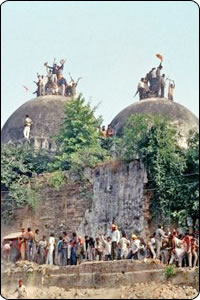
‘Faith’ was the single most important factor on which this issue was carried forward. Many middle class average Hindus also subscribed to the belief that Lord Ram was born there and Mughal King Babar in the 16th century demolished an existing temple and constructed a mosque which was known as the Babri Masjid post independence. On 6th December 1992, the Babri mosque was demolished by Hindu activists, which led to one of the worst communal riots in different parts of the country which claimed thousands of lives.

Without getting into different versions of history advocated by either side, the real issue is that the court will decide whether Lord Ram was born there and if a temple existed before the Babri mosque was constructed on that site. An issue which never got solved through an out of court talks that will be decided in the court of law on the basis of ‘material’, evidence & documents. Though all parties involved in the case which includes the right wing Hindu groups, Muslim groups and the political parties have appealed to maintain peace and accept the court verdict, almost all of them have suggested that the legal option of going to the Supreme Court is still open to them if either side is unhappy with the verdict. The irony of the situation is also the stand of two principle political parties which have been at the heart of the problem. The BJP which captured power on the back of this issue is now in a situation where it is trying to reposition itself as a moderate right wing party in order to strike a chord with the new generation. On the other hand the Congress which has never taken a clear stand on the issue and has changed its position depending on the prevailing political environment and is now in the process of regaining the confidence of the two opposing sides in this case-the Muslims which had deserted the party after the demolition and upper cast Hindus which traditionally supported the cause of the temple. In a sense everyone wants to avoid the verdict to prevent any communal disharmony to resurface.

A majority of average Indians today are of the opinion that the verdict really doesn’t matter now. India has moved on and there are more important issues that matter rather then a mosque or temple. Faith is a matter of trust in an idea. So the response of an average Indian irrespective of the religion after the verdict is something that will shape our faith in the idea of secularism. Majority of Hindus in India are secular in their thoughts and this has been proven by the previous few general elections where they did not vote for the right wing parties like the BJP which fought elections on the Hindutva plank. It has always been politicians (even in this Ayodhya issue) that have used religion to create disharmony by mixing politics with religion. But time and again post 1992, the secular faith of Indians have stood out against hard-line religious faith. Barring the Gujarat riots of 2002, Hindus & Muslims have stood united even when fundamental groups have targeted places of worship.

The ideal solution for this particular issue would be to construct a hospital at the disputed site which would do service to the society irrespective of religion. But no matter how romantic this idea of secularism may sound, the fact remains that history has been a testimony that even though India has changed from time to time, communal violence has been a constant part of our post independence history. And that is why cynics are worried that the Ayodhya verdict might just put the lid off the volcano and destroy the communal calm & peace that has prevailed for the last one decade. The court verdict on September 24th will not decide the winner between Hindus V/s Muslims but between the ‘Hard line Religious Faith’ V/s the ‘Indian Secular Faith’. And let’s hope that Gods of all religions bat for the latter.

Tuesday, September 14, 2010

RAHUL & SONIA'S NEW GAMEPLAN

Sonia and Rahul Gandhi’s recent political rhetoric to woo farmers and tribals gives a clear idea of Congress’s strategy for the coming four years before the general elections of 2014. Rahul’s staunch support for tribals against Anil Agarwal-owned Vedanta Group and Sonia’s support towards farmers has set the ball rolling for 2014 elections.

In the 2009 elections, three factors played a key role in bolstering Congress’s strength in the Lok Sabha:

1) The consolidated vote of the minorities, primarily the Muslims, which form 14% of the total votes.

2) The urban middle class voters, who traditionally voted for the BJP, overwhelmingly supported the Congress.


3) The Uttar Pradesh surprise where the party won 21 seats; thanks to the stupendous support it got from the farmers and Muslims. The Congress won 206 seats which were way better than the 2004 tally when they won only 145 seats. But, surprisingly, the UPA is finding it harder to cope with allies even though the ‘Left parties’ have become irrelevant this time around.

With Dr. Manmohan Singh serving his last term as the Prime Minister, the Gandhis realize that the call to make Rahul Gandhi as the next Prime Minister are going to get louder in 2014. Congress observers and insiders say that Rahul is very clear that he wants to head a Congress government without any coalition partners. And now, after regaining the confidence of Muslims and urban voters, the Congress wants to win the support of the remaining crucial vote banks.

Tribals form 8.2% of the total population of India according the 2001 census. Between 1947 and 2000, around 60 million people are estimated to have lost their means of livelihood in the name of development — of which a significant 40 per cent are tribal people. This initiative by the biggest political heavy weight - Rahul Gandhi is bound to get huge support among the tribals.

With over 65% of the population dependent on agriculture, the Congress does realize that farmers are not only a big vote bank but can turn the tide of any election. In the previous election - the farmers’ loan waiver scheme played a huge role in tapping the rural voters. Mamata’s political resurrection in West Bengal; thanks to the land acquisition issue and the farmers protest in Uttar Pradesh have a clear underlying message – take up the farmers’ prime cause and reap electoral benefits.

No wonder then that Rahul and Sonia have their objectives clear: to win the support of these two critical sections which will be instrumental to win a clear majority. But the peril of this strategy is that this could pose a worry for the middle class. In both these instances, it is the development and industrialization issues that will take a back seat and that may send a wrong message to the middle class which has been the biggest beneficiary of the Indian growth story. Though Rahul’s big strength is his popularity among the youth, the middle class gets easily wooed by symbolic gestures. Remember in the last election Dr. Manmohan Singh’s gamble to put his chair on the line for the nuclear deal did wonders for the Congress in urban centers.

The Gandhis are known to keep a close eye on the ground zero and they will try to strike a balance between development and social issues. But even a slight wrong footing could change the equation. It is a dangerous path that the mother-son duo is treading but risk is something that they are used to and this time it will be no different.